

‘I felt beaten up and for the first time wondered what my life was going to be like moving forward’
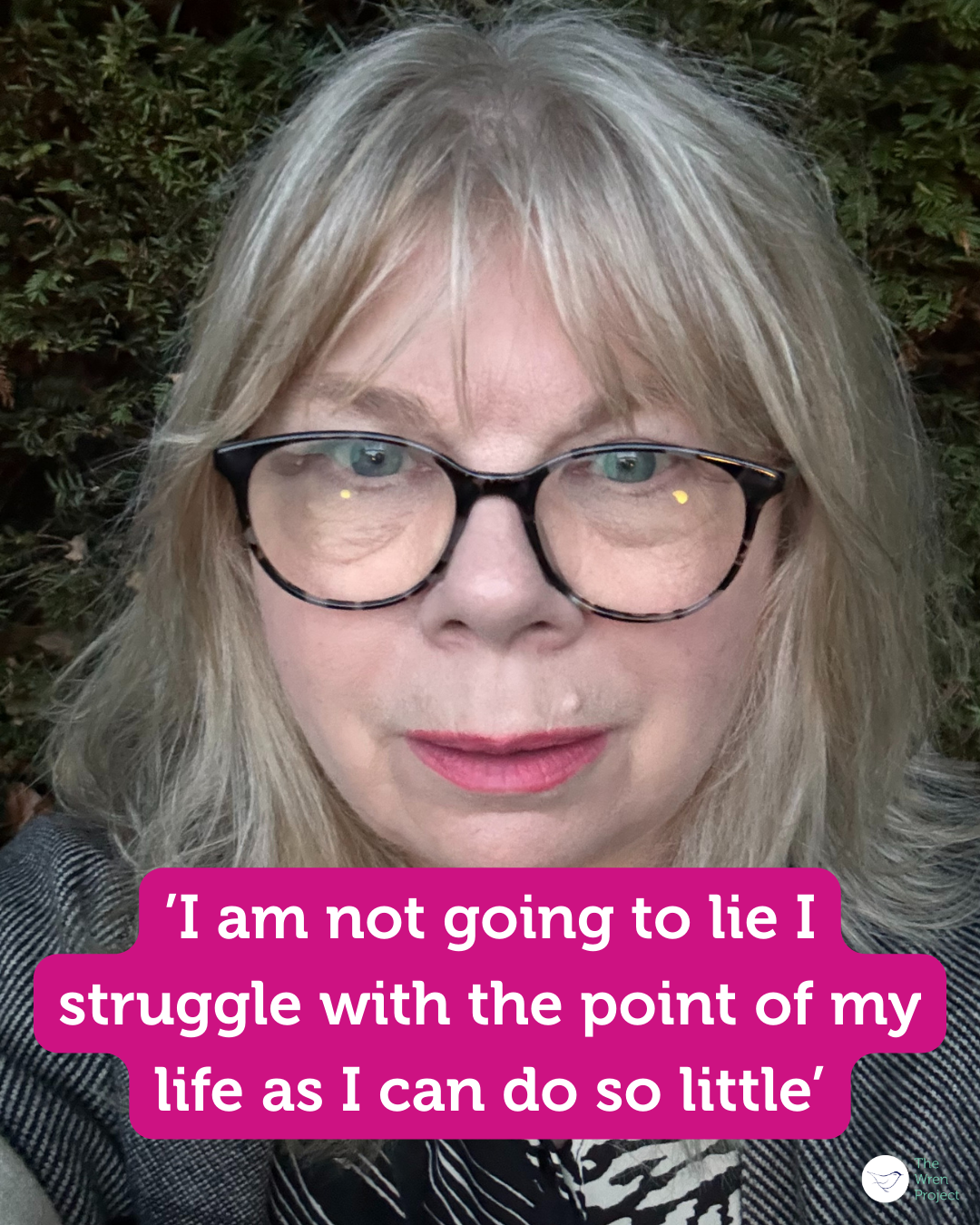
Dee, 60 from Owston Ferry, started experiencing autoimmune symptoms during the menopause, when she was initially diagnosed with rheumatoid arthritis. Later, she was diagnosed with multiple autoimmune conditions, including fibromyalgia and Raynaud’s. She reached out to the Wren Project when “things kept snowballing.”
“I had my menopause between 2014 and 2017 and I just kept feeling off,” she told us. “My joints started getting hot and painful and it was over a period of two years noticing it was constant and consistent [that] my GP recognised it.
“We went [through a number of medications] to try and reduce the pain. I was up most nights between two and five a.m. in agony and crying; the pain was so bad in my legs and hands.
“Eventually in June 2019 I was told I had rheumatoid arthritis. The pain at this point was horrific; sweat would pour down my face and my hands and ankles were not happy.”
However, rheumatoid arthritis was just the start of Dee’s conditions. “From there on, I became a collector of conditions,” she said.
In the early days of diagnosis, Dee and her husband thought things would be OK and that she could cope by taking the medications and “get on with her life.” Yet the medications she was initially given made her feel like a “zombie” and she simply couldn’t cope.
“[The medication] made me feel like a sloth; I could not cope with life. I just felt like a zombie. It was also during COVID times, so the management of it was slower and I felt I just had to get on with it.
“I started getting a lot of chest infections and my breathing was not right. One day, the MTX, penicillin and ibuprofen created a major storm, resulting in anaphylactic shock. My poor husband was so worried. The hospital and an ambulance sorted the situation and I had to come off all the medications that I could, but it was a shock to the system.”
In 2021, Dee was diagnosed with fibromyalgia, Raynaud’s, Sjogren’s, asthma and type 2 diabetes in 2021. A year later, it was confirmed she also had lumbar spondylitis, an overactive bladder, basal cell carcinoma and osteopenia.
“2022 was a bad year,” she explained. “I felt beaten up and for the first time in my life, wondered why I was here and what was my life going to be like moving forward. By the end of 2022, the charity National Rheumatoid Arthritis Society (NRAS) started talking about the Wren Project.
“In 2023 I reached out to the Wren Project as things just kept snowballing. I went on to be diagnosed with a number of other conditions, including diabetes retinopathy, COPD and I am now under investigation for ME/CFS.
“I am not going to lie, I struggle with the point of my life as I can do so little and after such an active busy life this complete turnaround is hard.”
The uncertainty and unpredictability of her illnesses meant Dee felt loved but alone, with so many diagnoses to grapple with. “[I had] daily issues from fatigue, headaches, insomnia, nightmares; high pain levels, itching, swellings, noise and light sensitivity and then just walking and breathing was so hard.”
However, Dee started taking more control of her health and pushing for appointments and referrals.
“If things don’t feel right, I know my body. I am not looking for things, but if something changes I need to know why.”
Dee said that the hardest part of her journey with autoimmune disease has been the grief.
“No longer being able to work - I loved work - a reduced social life, income gone and things I loved doing, like travel, reading and swimming [are] just no longer possible.
“My ability to retain information means re-reading books time and time again to remember the storyline.
“It has affected my friendships as I don’t travel as much and I suffer so badly with chronic fatigue. I am exhausted getting anywhere.”
Dee reached out to the Wren Project after being recommended listening support from our charity partner, NRAS.
“NRAS has a great support line but they felt I needed some time to talk and signposted me to the Wren Project. I looked at the website and immediately felt let’s do this and completed the forms online.
“In the first six support sessions, I think I cried in every session. My COPD and heart were unstable and rheumatoid arthritis were just hitting me hard. I felt alone and my volunteer just let me talk out what was in my head and made me feel heard.
“By the fourth session, my husband said it must be working as you are crying less and starting to smile again.”
Support from the Wren Project, having access to forums and other disease-specific organisations like NRAS have been a huge support to Dee. These resources showed her the importance of fighting for your own health - something which she recommends to others.
“You have to fight for your health and care and so keep track, keep a journal and if you feel bad on a certain medication, don’t sit there and say nothing.
“I kept a journal for three years and it helped me figure things out and be able to explain to consultants more clearly as I had descriptions of how things felt.”
She continued: “Don’t be afraid to ask why and what impact medications have. If you suffer from anxiety, reach out. Remember fatigue is not just tiredness and if it’s taking over your life, ask for help.
“Finally, don’t give up on hope. If you are having a bad day, you can go for a walk, sit in some fresh air (I do this even in winter with lots of layers) and get the sun on your face. Find your inner peace wherever you can find it.”
Dee shared her story with the Wren Project as part of our Wren Voices campaign. If you would like to share your story, you reach out to us by emailing here.